
New 2026 AI Transparency Laws for Sellers: Complete Guide
A single undisclosed AI-generated lifestyle image can now trigger an automatic listing suppression or a permanent shop ban across major marketplaces. As global regulators and platforms move from “guidelines” to “enforcement” in 2026, sellers must transition from casual AI experimentation to a strict, audit-ready compliance workflow.
Quick Answer: By August 2026, the EU AI Act requires machine-readable AI labels, while Amazon and TikTok Shop mandate disclosures for AI-generated humans and lifestyle scenes. Non-compliance risks €35M EU fines or permanent TikTok shop closures.
Quick Reference Table

Related: TikTok Shop AI Generated Label Shadowban Fix (2026) · Etsy AI Generated Art Transparency Requirements 2026 · TikTok Shop Invalid Tax ID Payout Error: How to Fix It
Run a full audit of your active listing catalog today against the following platform-specific thresholds to identify high-risk assets before enforcement dates pass.
| Platform / Law | Key Requirement | Deadline | Non-Compliance Penalty |
|---|---|---|---|
| EU AI Act | Machine-readable AI marking for all synthetic images | August 2, 2026 | €35M or 7% of global turnover |
| Amazon | Disclose AI-generated human models; 75-character title limit | July 27, 2026 | Listing suppression / AI title rewrite |
| TikTok Shop | Mandatory “AI-generated” tag; no exaggerated effects | Active Now | 3 strikes in 90 days = Permanent Closure |
| Etsy | Transparency label for AI-generated/edited content | Active Now | Search ranking demotion |
| NY SB8420A | Conspicuous label for “synthetic performers” (AI models) | June 9, 2026 | $1,000 to $5,000 per violation |
Detailed Requirements

Check your image metadata today using a standard IPTC viewer to ensure your AI tools are embedding “AI System Used” and “AI Prompt Information” tags, as IPTC Standard 2025.1 now requires these fields for synthetic media.
EU AI Act Article 50 Mandates
Under Article 50 of the EU AI Act, any AI system generating image content must mark outputs in a machine-readable format that is detectable as artificial. This is no longer just about a visible watermark; the requirement focuses on technical metadata (XMP/IPTC) that allows search engines and marketplace filters to automatically identify synthetic media. While the general deadline is August 2, 2026, the AI Omnibus agreement provides a small window until December 2, 2026, for generative systems already on the market to implement these technical watermarking standards.
Amazon’s AI Disclosure Updates
Amazon’s updated 2026 policies require sellers to declare if AI-generated people appear in their listing images, while enforcing a 75-character product title limit starting July 27. This title limit is a structural shift: Amazon will use AI to automatically rewrite and truncate titles that exceed this limit, potentially stripping out your most valuable keywords. To maintain control, you must manually shorten titles and move technical details to the new 125-character “Item Highlights” field, which remains searchable and visible in search results.
Furthermore, state-level laws like New York’s SB8420A specifically target “synthetic performers.” If your Amazon lifestyle images use AI-generated models to sell to New York residents, you must include a “clear and conspicuous” disclosure on the image itself. Failure to do so can result in civil penalties of up to $5,000 per subsequent violation after an initial $1,000 fine.
TikTok Shop’s Restricted Categories
TikTok Shop’s Commerce Content Policy places beauty, supplements, and electronics in a restricted category where AI imagery that exaggerates effects faces automatic rejection. TikTok uses image hashing and AI classifiers to detect synthetic media. If you use AI to show a product clearing skin or whitening teeth in a way that is “difficult to achieve in real life,” the listing will be flagged for misleading content. For all other categories, you must use the platform’s “AI-generated content” toggle during the upload process to avoid receiving a policy strike.
Common Rejection Reasons

💡 Skip the manual editing. PixelMatch batch-generates ecommerce-ready product images in 60 seconds — white background, lifestyle scenes, and variant mockups from a single source photo. Try PixelMatch free →
Run a side-by-side comparison of your AI-generated lifestyle shots against your original product photos to ensure the physical dimensions, color accuracy, and textures haven’t been altered by the AI’s diffusion process.
Exaggerated Product Claims
Listings are frequently suppressed on TikTok Shop for showing exaggerated product effects, such as instant skin clearing or teeth whitening in seconds, which violate their Commerce Content Policy. TikTok’s automated moderation is particularly aggressive toward AI-generated videos where the product’s performance is simulated rather than filmed. If the AI “hallucinates” a result that the physical product cannot deliver, it is classified as deceptive advertising.
Technical Image Spec Failures
Amazon rejects main images if the AI alters the physical product’s actual appearance or fails to use the required RGB 255, 255, 255 background. Many sellers use AI background removers that leave “artifacts” or gray-scale shadows that do not meet the pure white requirement. Additionally, Amazon recommends a minimum size of 2000×2000 pixels for zoom functionality; many low-cost AI upscalers introduce “smoothing” that makes the product look like a 3D render rather than a physical item, leading to rejections for “not representing the product accurately.”
Missing Metadata and Labels
European marketplaces will delist products lacking machine-readable metadata or visible AI-generated labels on synthetic lifestyle scenes once the August 2026 deadline passes. Etsy has already begun demoting listings in search results that appear to be AI-generated but lack the “Created with AI” disclosure. Unlike a total ban, this is a “trust signal” penalty — if the algorithm detects AI patterns but finds no label, it lowers the listing’s quality score, making it nearly impossible to rank for competitive keywords.
How to Fix Each Issue
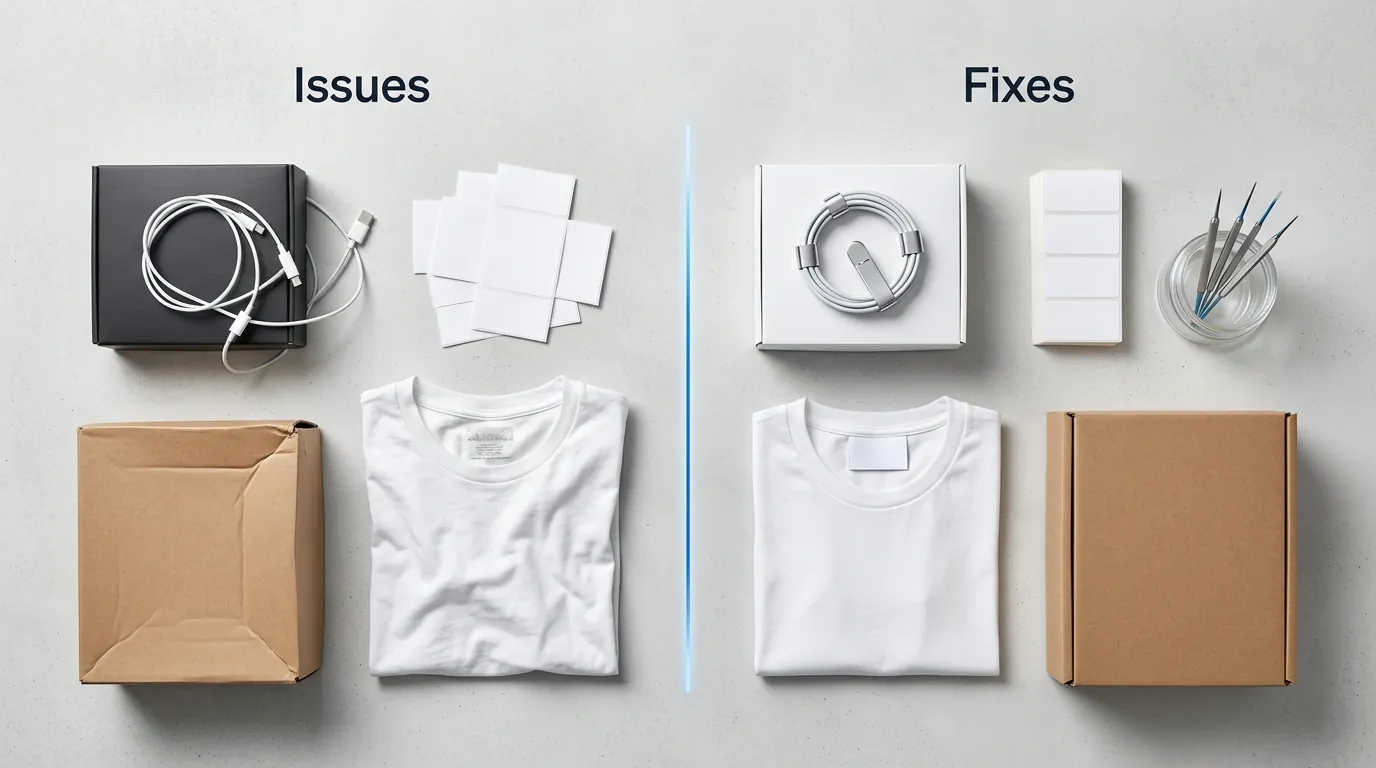
Audit your existing image catalog before the August 2, 2026 deadline to identify and label all synthetic media. Transitioning to a compliant workflow now prevents a “fire drill” when platforms begin mass-deleting non-compliant assets.
Step 1: Metadata Sanitization
Ensure your image generation workflow automatically embeds the required machine-readable metadata to satisfy EU AI Act detection requirements. Tools that follow the C2PA (Coalition for Content Provenance and Authenticity) standard are preferred, as they provide a verifiable “content credential” that tells platforms exactly which parts of the image were generated. If you are using older AI tools, you may need to use a metadata editor to manually add IPTC “AI System Used” tags to your master files.
Step 2: Use Pixel-Preserving AI
Use PixelMatch to batch-generate compliant lifestyle backgrounds; the tool preserves your core product pixels to prevent misleading alterations. The biggest risk with standard generative AI is that it “re-imagines” the product, changing the position of buttons, the texture of fabric, or the exact shade of a color. PixelMatch uses a “product-first” architecture that locks the original pixels of your product and only generates the environment around it. This ensures you meet the Amazon main image requirements 2026 for accuracy while still benefiting from AI-driven lifestyle scenes.
Step 3: Implement Multi-Platform Labeling
For every lifestyle image that includes an AI-generated human, add a small, legible text overlay stating “AI-generated model” or “Synthetic performer” in the bottom corner. This satisfies the New York SB8420A and California SB 942 requirements. On TikTok, always select the “AI-generated content” toggle in the “More options” section of the upload screen. This proactive disclosure prevents the “3 strikes” escalation that leads to permanent shop closure.
Step 4: Pricing and Tool Selection
If you are currently paying for a Pro-tier tool, verify that the features include metadata embedding. For example, Photoroom’s Pro tier at $12.99/mo offers batch processing and virtual models, but you must ensure your export settings are configured to retain metadata. Similarly, Adobe Express Premium at $9.99/mo integrates Content Credentials (C2PA) by default, which is a major advantage for EU compliance. Canva Pro at $12.99/mo also offers AI tools, but sellers must be diligent about manually adding disclosure text to designs intended for the NY or CA markets.
Official Source Links

- Review the official EU AI Act text for complete details on Article 50 transparency obligations and Article 99 penalty structures.
- Consult Amazon Seller Central for the latest updates on the July 27 title limit changes and AI-generated image declarations.
- Read the full TikTok Shop Seller Center guidelines on Artificial Intelligence Generated Content (AIGC) and the strike-based enforcement system.
- Check the Etsy Seller Handbook for the updated policy on disclosing AI-generated designs and product photography.
Frequently Asked Questions
Do I need to disclose AI if I only used it to remove a background?
Generally, no. Most platforms, including Amazon and the EU AI Act, distinguish between “assistive AI” (background removal, cropping, color correction) and “generative AI” (creating new scenes or people). If the AI did not “substantially alter” the product or create a synthetic person, disclosure is typically not required.
What happens if I miss the July 27 Amazon title deadline?
Amazon will use its own AI to automatically truncate or rewrite your titles to meet the 75-character limit. You will have a 14-day window to review and approve these changes, but if you do nothing, the AI-generated title will go live, which could negatively impact your SEO if it removes high-converting keywords.
How does TikTok detect undisclosed AI content?
TikTok uses a combination of digital watermarking, image hashing, and machine learning classifiers that look for common “artifacts” in AI-generated images, such as inconsistent lighting or distorted limb geometry. If their system detects a high probability of AI usage without a label, the listing is automatically flagged for review.
Will labeling my images as “AI-generated” hurt my conversion rate?
While some consumers are wary of AI, recent market research suggests that transparency actually builds more long-term brand trust than being “caught” using undisclosed synthetic media. For lifestyle images, a small, professional label is often ignored by shoppers but serves as a critical legal shield against platform bans.
Ready to scale your listings?
PixelMatch generates white-background, lifestyle, and variant mockups from a single source photo — built specifically for multi-platform ecommerce sellers. 50 free images on signup, no credit card.
Start free →
Sources
- https://artificialintelligenceact.eu/
- https://sellercentral.amazon.com/
- https://www.etsy.com/legal/policy/artificial-intelligence-ai/1273874841595
- https://www.nysenate.gov/legislation/bills/2023/S8420
- https://iptc.org/std/photometadata/specification/IPTC-PhotoMetadata
- https://www.photoroom.com/pricing
- https://www.adobe.com/express/pricing
- https://www.canva.com/pricing/